
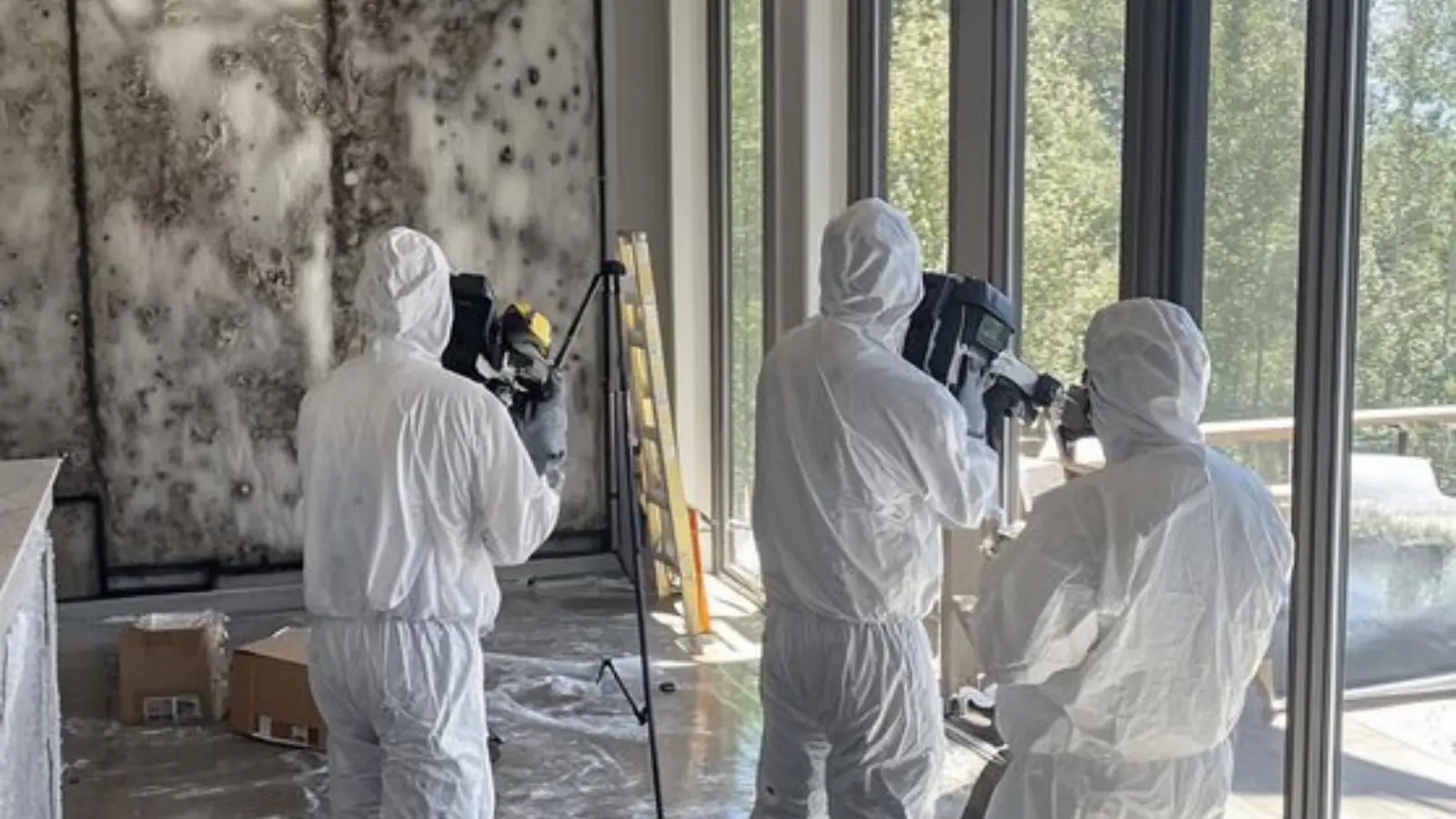
The offer is accepted, escrow is open, and then the inspection report mentions dark growth in a hall closet or under a bathroom. A few days later the lender says the loan will not close until the mold is removed and the house is shown to be clean. This is the situation behind a steady share of the mold calls we hear.
Four words get used almost interchangeably in that moment: inspection, testing, verification and clearance. They are different jobs with different people, and mixing them up costs time you do not have. This guide separates them and ends with a step table you can follow.
Four terms that sound alike and are not
Inspection
A person looks at the home, takes moisture readings with a meter and a thermal imaging camera, and writes down where growth or dampness is and what is feeding it. It answers: where is it and why?
Testing
Samples of air or surfaces go to a lab. It answers whether spores are present and in what mix. Testing is useful as a comparison, such as inside versus outside, but it does not tell you how to fix the cause.
Post-remediation verification
A check after the work that the affected area is dry, clean and shows no visible growth. It can be a visual and moisture check, sometimes with samples, and it can be done by the company that did the removal.
Independent clearance
A verification done by a separate party that has no stake in the removal. That party sets the criteria before work begins, and then confirms after work whether they were met.
Why the company that removes mold should not be the only one checking it
It is a simple conflict of interest. The party paid to finish the job would also be the one marking it complete. Nobody needs to act in bad faith for that to be a weak arrangement, because a buyer, a lender and an agent all have reasons to want an outside signature. A neutral party who does not sell removal has nothing to gain from a pass or a fail.
Lenders and agents differ on what they will accept, and some accept the remediator's own documentation. So ask first. Call your lender and your agent and ask them to tell you in writing what proof they require, who must produce it and what format the report must take. A short list from them saves you from paying for a report nobody wants.
The order of operations, step by step
| Step | Who does it | What happens | Ask this |
|---|---|---|---|
| 1. Get requirements | You, your lender and your agent | Lender and agent state what documents they will accept and who may write them | Do you need an independent report, and in what format? |
| 2. Inspect | Inspector, assessor or restoration technician | Visual survey and moisture readings find growth, the water source and the extent | Where is the moisture coming from, and is it still active? |
| 3. Stop the water | Plumber, roofer or HVAC technician | The leak or condensate problem is fixed before anything else | Is the area drying, and how do we know? |
| 4. Write the plan | Independent assessor, or the remediator | A written scope sets what is removed, how the area is contained and what counts as finished | Who wrote the scope and what are the pass criteria? |
| 5. Remove and dry | Remediation crew | Containment barriers, HEPA air scrubbers and removal of affected materials under ANSI/IICRC S520, followed by drying | How do you apply S520 on this job? |
| 6. Verify and clear | Independent party if required | Visual check, moisture readings and any sampling the plan calls for | Does the report match what the lender asked for? |
| 7. Rebuild and close | Repair contractor, then escrow | Drywall, paint and flooring replaced once clearance is in hand | When can the report go to escrow? |
Notice that the water source is fixed before the removal crew comes in. Cleaning a wall that is still wet is the quickest way to end up with a failed clearance. If you are still working out what is wet, mold remediation starts with an assessment and an explanation of scope and price before any work.
What testing can and cannot tell you
An air sample is a snapshot of one room on one day. Spore counts change with weather, open doors and whether a fan is running, which is why a good plan compares samples against an outdoor reference and against the same room's own results. A clean sample does not say the wall behind the closet is dry, and a high one does not locate the leak.
That is why moisture readings and a visual survey usually come first. If the structure is wet, no passing test can be trusted. If it is dry and the surface shows no visible growth, lab results become supporting evidence rather than the whole case.
After clearance: the rebuild
Once the report is accepted, the opened walls and removed flooring still need to be put back. Water damage repair covers the drywall, texture, paint and flooring work. Neighbors in Canoga Park and Chatsworth run into the same escrow deadline, so describe yours when you call (818) 337-2642.
Licensing questions and what a loan delay means at West Hills prices
The Contractors State License Board's classification list does not include a mold or water damage restoration classification. It does list classifications like C-22 Asbestos Abatement, C-36 Plumbing and C-9 Drywall, and a hazardous substance removal certification. Do not read that as a statement about whether California licenses mold work. Instead, ask each company whether your state licenses mold work and what credentials it holds, and check any contractor's license on the board's site.
The U.S. Census Bureau's American Community Survey, 2024 five-year estimate, puts median owner-occupied home value in ZIP Code Tabulation Area 91307 at $963,900, with a margin of error of $21,147. With a price around that level, a lender's hold is costly in time and interest. It makes the early call to your lender, and a written scope, worth the effort.
Source: CSLB classification list, Census Reporter profile of ZCTA 91307 (ACS 2024 5-year estimate)
What to put in the file for escrow
- The written requirements from your lender and agent.
- The inspection report with moisture readings and photos of each affected area.
- The plumber's or roofer's invoice showing the source was fixed.
- The written remediation scope, and the final invoice for the work.
- The verification or clearance report, with the date and the name of the party who wrote it.
We cannot promise how a lender or buyer will respond to any report. We can explain the scope clearly, document the work and tell you what to ask, which gives your agent something solid to send.
Questions about mold testing and clearance
Is there a state license for mold testing or removal that I should look for in West Hills?
The Contractors State License Board lists no mold or water damage restoration classification, but that is not the same as saying nothing applies. Ask each company whether your state licenses mold work and which credentials it holds. Then look up the company's contractor license on the board's website, since a project of $1,000 or more in labor and materials generally needs a licensed contractor.
Who pays for mold clearance when a West Hills home is being sold?
That is negotiated between buyer and seller, and your agent and escrow officer can advise. Ask your lender who must commission the report and what it should say. Get the arrangement in writing before work begins.
Is a mold inspection the same as a mold test?
No. An inspection is a visual survey with moisture readings that locates growth and the water source. A test sends air or surface samples to a lab. Inspections usually come first, and testing supports the findings. Neither fixes the cause.
What is independent clearance and do I always need it?
Independent clearance is verification by a party that does not perform the removal. You do not always need it. Some lenders and buyers accept the remediator's own documentation, others ask for an outside report. Ask your lender and agent what they require before spending money.
Does a passing test mean mold stays gone?
No. A passing result describes conditions at the time of sampling. Mold needs moisture, so a new leak or poor drying can bring growth back. Keep the repaired source dry and watch humidity. Health questions belong with a physician.
How soon can I get someone to look at mold during escrow?
Call (818) 337-2642 and describe the closing date and what the lender asked for. Bring the inspection report if you have one. Same-day response is available when crews are on hand, and the scope and cost come first.